Hello, this is Nawe Women's Clinic.
Many women consider labiaplasty for different reasons.
Some feel discomfort when wearing tight clothing. Some feel irritation during exercise. Others feel self-conscious about the shape or size of the labia and want to feel more comfortable in their daily life.
But before deciding on surgery, one of the biggest questions is usually this:
"How long does labiaplasty recovery actually take?"
The good news is that labiaplasty recovery is usually manageable when patients understand the healing process and follow proper aftercare. While every patient heals at a different speed, most people can return to light daily activities within a few days to 1–2 weeks. However, exercise, cycling, swimming, tampon use, and sexual activity usually need to be avoided for around 4–6 weeks, or until the doctor confirms that healing is stable.
What You Will Learn in This Article
- What Is Labiaplasty, and Why Does Recovery Time Matter?
- Labiaplasty Recovery Timeline: Week-by-Week Guide
- Important Precautions After Labiaplasty
- What Makes NAWE Clinic Special
What Is Labiaplasty, and Why Does Recovery Time Matter?
Labiaplasty is a surgical procedure that reshapes or reduces the labia, most commonly the labia minora, which are the inner folds of skin around the vaginal opening.
Some women consider labiaplasty because they feel discomfort when wearing tight clothing, exercising, cycling, or during intimate moments. Others may feel concerned about the size, shape, or asymmetry of the labia.
The goal of labiaplasty is not only to improve appearance, but also to help reduce discomfort and support confidence in daily life. The procedure is usually performed as an outpatient surgery, and the method may vary depending on each patient's anatomy, concerns, and desired result.
Because labiaplasty is performed on a delicate area, recovery should not be rushed. Temporary swelling, sensitivity, tightness, or mild discomfort can be normal during healing.
Even if you feel better after a few days, the deeper tissues still need time to recover. Giving your body enough time to heal helps the area feel more natural, comfortable, and stable again.
Understanding Labiaplasty Recovery: Timeline, Care, and Results
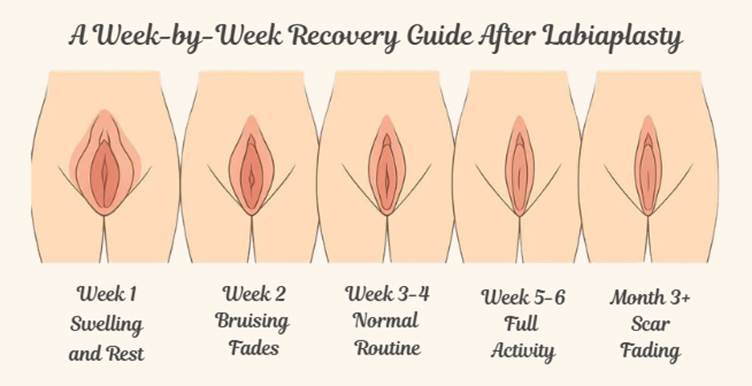
The First Few Days After Labiaplasty
During the first few days after labiaplasty, it is completely normal to experience swelling, tenderness, mild bruising, or slight discomfort. This is a natural part of the healing process as the body begins to recover. During this early stage, rest plays a very important role in supporting proper healing.
Patients are usually advised to avoid long periods of walking, tight underwear, friction, heavy physical activity, and any pressure on the surgical area. Light and gentle movement is generally fine, but the priority should be to keep the area as relaxed and undisturbed as possible.
Wearing loose, breathable clothing and soft cotton underwear can help reduce irritation and improve comfort. Maintaining gentle hygiene is also essential during this time. It is recommended to cleanse the area using lukewarm water only, and to carefully pat the area dry rather than rubbing, to avoid unnecessary irritation.
Week 1: Early Recovery and Gentle Care
By the end of the first week, many patients begin to feel more comfortable as the initial discomfort slowly improves. Simple daily activities may feel easier, and some patients may return to light work if their routine does not involve physical strain.
However, this stage is still part of the early healing process. Swelling and sensitivity are completely normal, and the tissue has not yet fully recovered. Even if you feel better, it is important to continue protecting the area by avoiding exercise, cycling, squatting, or any activity that causes pressure or friction.
To support recovery during this stage, patients are advised to rest as much as possible, wear loose-fitting clothing and soft cotton underwear, and keep the area clean using lukewarm water. Gently patting the area dry, rather than rubbing, can help prevent irritation. Minimizing movement and avoiding prolonged sitting can also reduce swelling.
We often remind patients of one key idea: feeling better does not mean fully healed. For this reason, taking this stage seriously and following aftercare instructions carefully is essential for proper recovery.
Weeks 2–3: Feeling Better, But Still Healing
During weeks two to three, most patients notice a clear improvement in comfort. Walking, sitting, and daily routines usually become much easier, and swelling often begins to decrease.
Because of this progress, it can be tempting to return to normal activities too quickly. However, the deeper tissue is still healing, even if the surface feels better. Rushing this stage may cause irritation or delay recovery.
To continue healing safely, patients should still avoid cycling, swimming, intense exercise, tampon use, and sexual activity unless advised otherwise by their doctor. Gentle daily movement is encouraged, but it is important to listen to your body and avoid overexertion.
Helpful habits during this stage include maintaining good hygiene, avoiding tight clothing, staying well-hydrated, and following any prescribed medications or care instructions. Taking care during this period supports a smoother and more comfortable recovery.
Weeks 4–6: Gradual Return to Daily Life
Between weeks four and six, recovery typically feels much easier. Swelling is significantly reduced, and the treated area begins to feel more natural and comfortable in everyday life.
Even so, healing is still in progress. Activities that place pressure on the area such as running, cycling, swimming, or sexual activity should only be resumed after confirmation from your doctor.
To support recovery at this stage, patients should continue wearing comfortable clothing, avoid sudden or high-impact movements, and attend follow-up appointments to monitor healing progress. Gradually increasing activity levels, rather than rushing back into a full routine, is key to protecting the results.
After 6 Weeks: Recovery Continues Beyond the Surface
After about six weeks, many patients are able to return to most normal activities, depending on their individual healing progress. At this point, comfort has usually improved significantly, and daily life feels more stable.
However, recovery does not end here. The body continues to heal and refine the treated area over time. While most swelling improves within the first six weeks, mild swelling may remain for several months, and final results typically become clearer over time.
To support long-term healing, patients should continue to follow medical guidance, avoid unnecessary irritation, and allow the body to recover at its own pace. Patience during this stage helps ensure the best and most natural outcome.
Important Precautions After Labiaplasty
After labiaplasty, careful aftercare can make recovery more comfortable.
Patients are usually advised to:
- Wear loose clothing and soft underwear
- Keep the surgical area clean and dry
- Avoid rubbing or strong pressure
- Avoid long walking during early recovery
- Avoid strenuous exercise until cleared by the doctor
- Avoid cycling, swimming, sauna, and hot baths during early healing
- Avoid sexual intimacy for about 4–6 weeks or until approved by the doctor
- Attend follow-up visits if recommended
- Contact the clinic if pain, swelling, bleeding, discharge, or fever becomes unusual
It is important not to rush the healing process. Even if daily life feels easier after a short time, the delicate tissue still needs several weeks to recover properly.
What Makes NAWE Clinic Special
At NAWE Women's Clinic, we understand that labiaplasty is a very personal procedure.
Our goal is not simply to reduce the size of the labia. We focus on creating a natural-looking shape, balanced symmetry, and a result that feels comfortable in daily life. Another special part of NAWE Clinic's care is our 4-session aftercare program.
After labiaplasty, NAWE Clinic provides aftercare using Bellalux to support the recovery process. Bellalux care is used to help with:
Bellalux Aftercare Benefits
- Skin regeneration support
- Inflammation care
- Swelling reduction
- Brightening care
- Pigmentation control support
LED-based care is commonly used in aesthetic settings to support skin calming and recovery, and research on light-based therapy has also discussed its role in supporting tissue repair and skin healing responses.
At NAWE Clinic, aftercare is not treated as an extra detail. We believe recovery support is an important part of helping patients feel more comfortable and cared for after surgery.
Each patient's healing process can be different, so the doctor will check your condition and guide you based on your recovery progress.
Summary: What to Expect from Labiaplasty Recovery
Labiaplasty recovery is usually more manageable than many patients expect, but it still requires time, patience, and proper care. Most patients can return to light daily activities within a short period, but because the labial tissue is delicate, the area still needs several weeks to heal properly.
For the best results, it is important not to rush the recovery process. Returning too quickly to exercise or intimate activity may place pressure on the healing area and affect both comfort and results. Following the doctor's aftercare instructions and allowing your body enough time to recover can help support a smoother and more comfortable healing process.
Labiaplasty methods have also improved over time. Traditional labiaplasty mainly focused on removing excess labial tissue, which could involve more incision sites, a longer recovery period, and a higher chance of visible scarring after healing.
Today, the focus is not only on reducing tissue, but also on creating a natural shape, balanced symmetry, and comfortable results. At NAWE Women's Clinic, our labiaplasty approach is designed to minimize visible scarring as much as possible while helping patients achieve a natural-looking result. Many patients can expect recovery within about a month, although the exact timeline may vary depending on each individual's condition and healing process.
Before recommending surgery, our doctor carefully checks each patient's anatomy, concerns, and desired outcome. The goal is not simply to make the labia smaller, but to create a result that looks natural and feels comfortable in daily life.
If you are considering labiaplasty, a private 1:1 consultation can help you understand whether the procedure is suitable for you, what your recovery timeline may look like, and how to plan your schedule safely.
Thank you for reading. This is Nawe Clinic.
Like a friend, sometimes like a sister —
Dr. Eun-jeong Lee, a physician who truly understands women.
• OB/GYN Specialist, Samsung Seoul Hospital
• Outpatient Professor, Samsung Seoul Hospital Dept. of OB/GYN
• Former Director, Yunho Hospital OB/GYN
• Former Director, Poyumun OB/GYN Clinic
• Current Director, Nawe Clinic
• Full Member, Korean Society of Obstetrics and Gynecology
• Full Member, Korean OB/GYN Medical Association
• Full Member, Korean Society of Obstetric and Gynecologic Ultrasound
• Full Member, Korean Society of Female Pelvic Aesthetic Medicine
• Full Member, Korean Society of Urogynecology

 Nearby exit 4 of

 Walk-in








Hello, this is Nawe Women's Clinic.
Many women consider labiaplasty for different reasons.
Some feel discomfort when wearing tight clothing. Some feel irritation during exercise. Others feel self-conscious about the shape or size of the labia and want to feel more comfortable in their daily life.
But before deciding on surgery, one of the biggest questions is usually this:
The good news is that labiaplasty recovery is usually manageable when patients understand the healing process and follow proper aftercare. While every patient heals at a different speed, most people can return to light daily activities within a few days to 1–2 weeks. However, exercise, cycling, swimming, tampon use, and sexual activity usually need to be avoided for around 4–6 weeks, or until the doctor confirms that healing is stable.
What You Will Learn in This Article
- What Is Labiaplasty, and Why Does Recovery Time Matter?
- Labiaplasty Recovery Timeline: Week-by-Week Guide
- Important Precautions After Labiaplasty
- What Makes NAWE Clinic Special
What Is Labiaplasty, and Why Does Recovery Time Matter?
Labiaplasty is a surgical procedure that reshapes or reduces the labia, most commonly the labia minora, which are the inner folds of skin around the vaginal opening.
Some women consider labiaplasty because they feel discomfort when wearing tight clothing, exercising, cycling, or during intimate moments. Others may feel concerned about the size, shape, or asymmetry of the labia.
The goal of labiaplasty is not only to improve appearance, but also to help reduce discomfort and support confidence in daily life. The procedure is usually performed as an outpatient surgery, and the method may vary depending on each patient's anatomy, concerns, and desired result.
Because labiaplasty is performed on a delicate area, recovery should not be rushed. Temporary swelling, sensitivity, tightness, or mild discomfort can be normal during healing.
Even if you feel better after a few days, the deeper tissues still need time to recover. Giving your body enough time to heal helps the area feel more natural, comfortable, and stable again.
Understanding Labiaplasty Recovery: Timeline, Care, and Results
The First Few Days After Labiaplasty
During the first few days after labiaplasty, it is completely normal to experience swelling, tenderness, mild bruising, or slight discomfort. This is a natural part of the healing process as the body begins to recover. During this early stage, rest plays a very important role in supporting proper healing.
Patients are usually advised to avoid long periods of walking, tight underwear, friction, heavy physical activity, and any pressure on the surgical area. Light and gentle movement is generally fine, but the priority should be to keep the area as relaxed and undisturbed as possible.
Wearing loose, breathable clothing and soft cotton underwear can help reduce irritation and improve comfort. Maintaining gentle hygiene is also essential during this time. It is recommended to cleanse the area using lukewarm water only, and to carefully pat the area dry rather than rubbing, to avoid unnecessary irritation.
Week 1: Early Recovery and Gentle Care
By the end of the first week, many patients begin to feel more comfortable as the initial discomfort slowly improves. Simple daily activities may feel easier, and some patients may return to light work if their routine does not involve physical strain.
However, this stage is still part of the early healing process. Swelling and sensitivity are completely normal, and the tissue has not yet fully recovered. Even if you feel better, it is important to continue protecting the area by avoiding exercise, cycling, squatting, or any activity that causes pressure or friction.
To support recovery during this stage, patients are advised to rest as much as possible, wear loose-fitting clothing and soft cotton underwear, and keep the area clean using lukewarm water. Gently patting the area dry, rather than rubbing, can help prevent irritation. Minimizing movement and avoiding prolonged sitting can also reduce swelling.
We often remind patients of one key idea: feeling better does not mean fully healed. For this reason, taking this stage seriously and following aftercare instructions carefully is essential for proper recovery.
Weeks 2–3: Feeling Better, But Still Healing
During weeks two to three, most patients notice a clear improvement in comfort. Walking, sitting, and daily routines usually become much easier, and swelling often begins to decrease.
Because of this progress, it can be tempting to return to normal activities too quickly. However, the deeper tissue is still healing, even if the surface feels better. Rushing this stage may cause irritation or delay recovery.
To continue healing safely, patients should still avoid cycling, swimming, intense exercise, tampon use, and sexual activity unless advised otherwise by their doctor. Gentle daily movement is encouraged, but it is important to listen to your body and avoid overexertion.
Helpful habits during this stage include maintaining good hygiene, avoiding tight clothing, staying well-hydrated, and following any prescribed medications or care instructions. Taking care during this period supports a smoother and more comfortable recovery.
Weeks 4–6: Gradual Return to Daily Life
Between weeks four and six, recovery typically feels much easier. Swelling is significantly reduced, and the treated area begins to feel more natural and comfortable in everyday life.
Even so, healing is still in progress. Activities that place pressure on the area such as running, cycling, swimming, or sexual activity should only be resumed after confirmation from your doctor.
To support recovery at this stage, patients should continue wearing comfortable clothing, avoid sudden or high-impact movements, and attend follow-up appointments to monitor healing progress. Gradually increasing activity levels, rather than rushing back into a full routine, is key to protecting the results.
After 6 Weeks: Recovery Continues Beyond the Surface
After about six weeks, many patients are able to return to most normal activities, depending on their individual healing progress. At this point, comfort has usually improved significantly, and daily life feels more stable.
However, recovery does not end here. The body continues to heal and refine the treated area over time. While most swelling improves within the first six weeks, mild swelling may remain for several months, and final results typically become clearer over time.
To support long-term healing, patients should continue to follow medical guidance, avoid unnecessary irritation, and allow the body to recover at its own pace. Patience during this stage helps ensure the best and most natural outcome.
Important Precautions After Labiaplasty
After labiaplasty, careful aftercare can make recovery more comfortable.
Patients are usually advised to:
- Wear loose clothing and soft underwear
- Keep the surgical area clean and dry
- Avoid rubbing or strong pressure
- Avoid long walking during early recovery
- Avoid strenuous exercise until cleared by the doctor
- Avoid cycling, swimming, sauna, and hot baths during early healing
- Avoid sexual intimacy for about 4–6 weeks or until approved by the doctor
- Attend follow-up visits if recommended
- Contact the clinic if pain, swelling, bleeding, discharge, or fever becomes unusual
It is important not to rush the healing process. Even if daily life feels easier after a short time, the delicate tissue still needs several weeks to recover properly.
What Makes NAWE Clinic Special
At NAWE Women's Clinic, we understand that labiaplasty is a very personal procedure.
Our goal is not simply to reduce the size of the labia. We focus on creating a natural-looking shape, balanced symmetry, and a result that feels comfortable in daily life. Another special part of NAWE Clinic's care is our 4-session aftercare program.
After labiaplasty, NAWE Clinic provides aftercare using Bellalux to support the recovery process. Bellalux care is used to help with:
Bellalux Aftercare Benefits
- Skin regeneration support
- Inflammation care
- Swelling reduction
- Brightening care
- Pigmentation control support
LED-based care is commonly used in aesthetic settings to support skin calming and recovery, and research on light-based therapy has also discussed its role in supporting tissue repair and skin healing responses.
At NAWE Clinic, aftercare is not treated as an extra detail. We believe recovery support is an important part of helping patients feel more comfortable and cared for after surgery.
Each patient's healing process can be different, so the doctor will check your condition and guide you based on your recovery progress.
Summary: What to Expect from Labiaplasty Recovery
Labiaplasty recovery is usually more manageable than many patients expect, but it still requires time, patience, and proper care. Most patients can return to light daily activities within a short period, but because the labial tissue is delicate, the area still needs several weeks to heal properly.
For the best results, it is important not to rush the recovery process. Returning too quickly to exercise or intimate activity may place pressure on the healing area and affect both comfort and results. Following the doctor's aftercare instructions and allowing your body enough time to recover can help support a smoother and more comfortable healing process.
Labiaplasty methods have also improved over time. Traditional labiaplasty mainly focused on removing excess labial tissue, which could involve more incision sites, a longer recovery period, and a higher chance of visible scarring after healing.
Today, the focus is not only on reducing tissue, but also on creating a natural shape, balanced symmetry, and comfortable results. At NAWE Women's Clinic, our labiaplasty approach is designed to minimize visible scarring as much as possible while helping patients achieve a natural-looking result. Many patients can expect recovery within about a month, although the exact timeline may vary depending on each individual's condition and healing process.
Before recommending surgery, our doctor carefully checks each patient's anatomy, concerns, and desired outcome. The goal is not simply to make the labia smaller, but to create a result that looks natural and feels comfortable in daily life.
Thank you for reading. This is Nawe Clinic.
Dr. Eun-jeong Lee, a physician who truly understands women.
• Outpatient Professor, Samsung Seoul Hospital Dept. of OB/GYN
• Former Director, Yunho Hospital OB/GYN
• Former Director, Poyumun OB/GYN Clinic
• Current Director, Nawe Clinic
• Full Member, Korean OB/GYN Medical Association
• Full Member, Korean Society of Obstetric and Gynecologic Ultrasound
• Full Member, Korean Society of Female Pelvic Aesthetic Medicine
• Full Member, Korean Society of Urogynecology